
On this page
- Cents come first; prize rounding comes afterwards
- A percentage prize and a 50/50 split use different rules
- The award and the amount taken from the pot can differ
- A receipt date is different from its entry time
- A backdated receipt may still follow that day’s drawing
- Drawing times and scheduled dates answer different questions
- An event link supplies the schedule
- A game-linked Money ledger copies the money records
- A ledger link does not move money
- What In step means
- A difference needs context
- Matching records are not an independent cash check
- Keep the comparisons separate
Cents come first; prize rounding comes afterwards
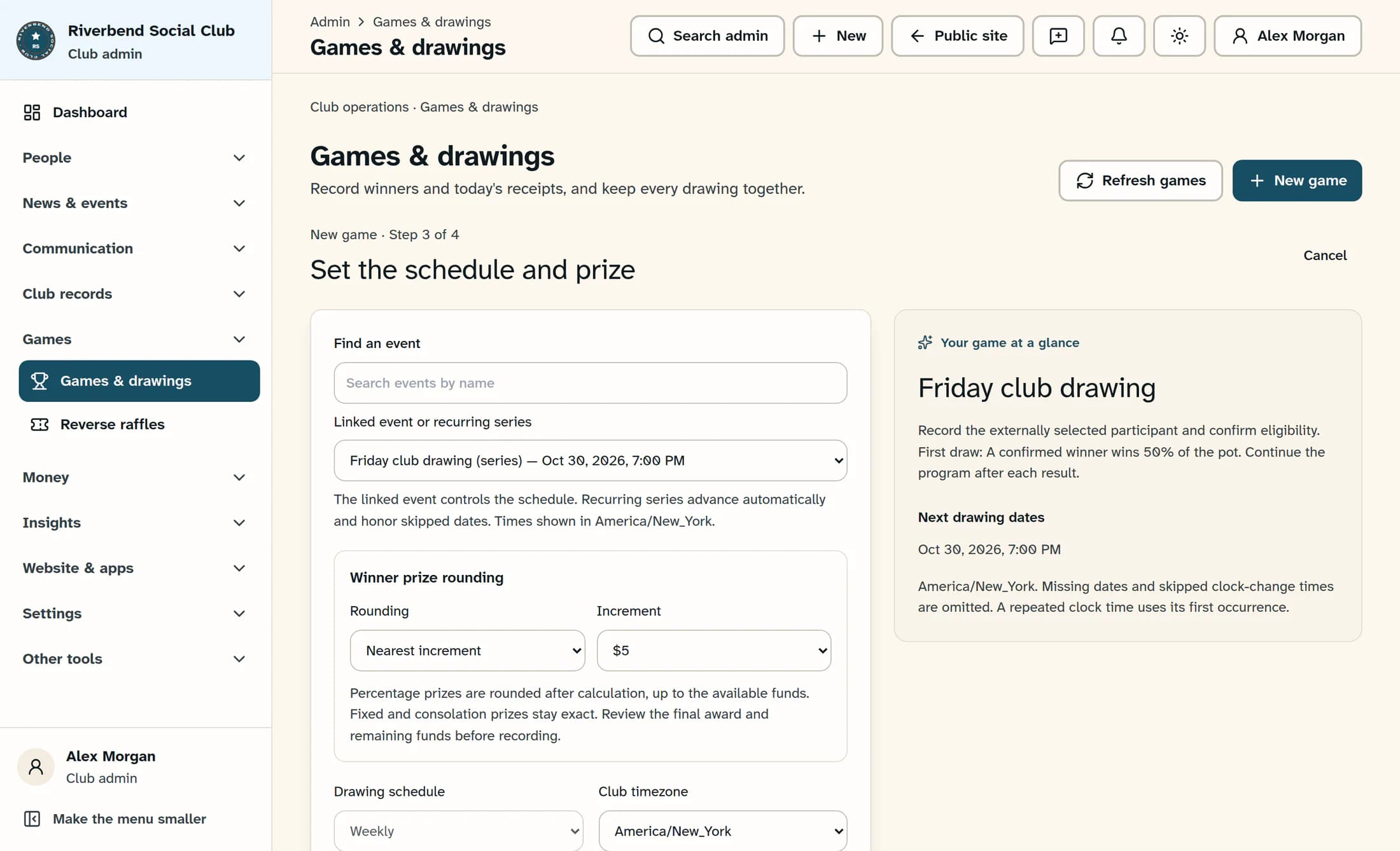
Money is recorded in cents, with money-entry fields accepting up to two decimal places. For a percentage prize, ClubWorks calculates a cent amount first, then applies the chosen Winner prize rounding rule: Exact cents, Nearest increment, Round up or Round down. The available increments are $1, $5, $10, $25, $50 and $100; a rounded percentage prize cannot exceed the available pool.
A percentage prize and a 50/50 split use different rules
A 50% percentage prize from $1,234.56 starts at $617.28: the nearest $5 gives $615, while rounding up to $5 gives $620. A literal 50/50 split independently rounds the winner’s half down to a whole cent, so a $100.01 pool gives the winner $50.00 and, with no other awards, leaves $50.01 for the club. A fixed $12.34 prize or an explicitly typed amount stays exact; the percentage rounding setting does not change it.
The award and the amount taken from the pot can differ
A prize can be paid from the pot or separately, and retained funds have their own meaning. The final award, pot-funded amount, separately paid amount and remaining funds describe those different allocations. A deliberate pot correction is another kind of record, so an award amount alone does not tell you how much the pot decreased.
A receipt date is different from its entry time
The selected receipt or correction date represents the operational day in the club’s timezone. A backdated day is stored at 11:59:59 PM on that club-local day; an entry without an explicit past date uses its creation time. The game’s money records use that operational time when present, otherwise the creation time, and dated records can show a separate entered timestamp.
A backdated receipt may still follow that day’s drawing
Pot at this time excludes receipts and adjustments dated after the drawing; this calculation does not remove later opening-fund or transfer entries in the same way. For example, a receipt entered on October 25 but dated October 24 in America/New_York represents October 24 at 11:59:59 PM there, so it is later than a 7 PM drawing on October 24. A drawing after the end of that day includes the receipt; this example explains the timing and is not a reason to change a real financial date.
Drawing times and scheduled dates answer different questions
The actual drawing-time input uses this device’s local time, while game workspace history uses the game schedule’s timezone when configured, otherwise the club’s timezone. The Money ledger uses the club’s timezone. Results are recorded in time order. The next scheduled event or drawing date describes a future plan, not the time at which a result actually happened.
An event link supplies the schedule
A game’s Linked event or recurring series supplies its future drawing schedule, including skipped dates in a recurring series. A link attached to one drawing applies only to that result and leaves the game’s schedule unchanged. Neither kind of event link is the Money ledger link that copies financial records.
A game-linked Money ledger copies the money records
A linked ledger follows the game program across its runs from the link’s configured starting instant, copying eligible receipts, payouts, adjustments and carry entries with their source identity intact. The copied ledger date comes from the effective money time converted to the club’s local date; paired carry-out and carry-in entries can cancel each other out across runs. Hand-entered money lines are blocked while the ledger is linked, but comments, checks and flags remain available.
A ledger link does not move money
Unlinking keeps the lines already copied into the ledger. The link is a copy of game records, not a connection to a bank or payment service. Access also stays separate: permission to operate games does not automatically grant access to every ledger, and link settings require ledger-management access.
What In step means
In step means the compared totals match and there are no missing eligible source lines. While the program has an active or paused run, the comparison uses the sum of pot-entry records for its active or paused runs; between runs it compares the program’s pot-entry records across its runs. Although the status may call the comparison the pot, it does not directly compare against the separately stored jackpot amount displayed elsewhere.
A difference needs context
An opening balance or imported lines from before the link still count in the ledger, and the link’s starting instant limits which past game entries are copied. For example, a $170 ledger containing a $100 pre-link opening amount can differ by $100 from $70 of compared game records even when no lines are missing. A game operation can also succeed when its ledger copy fails, so matching visible totals alone do not prove that every source line arrived.
Matching records are not an independent cash check
In step is a record comparison, not proof of bank settlement, physical cash on hand or agreement with every current-pot display. In the game’s own Receipts, awards and transfers table, running Balance figures appear only when its entries reconcile to the stored current jackpot and the pot status permits them. Understanding a difference depends on the source dates, link start, existing ledger lines and missing-line count; this guide does not prescribe balancing entries or a repair procedure.
The illustration uses fictional data and is reconstructed from the application source. It shows the newer Clubhouse Games layout, which may not be enabled for your club; it is not a live financial record or evidence of a real transaction.
Keep the comparisons separate
Prize rules determine an award, dates determine which records belong at a drawing’s time, and links control either scheduling or copied money records. Each total is meaningful within its own rules and scope.